As a simple example, a baby with thing-level meta-experience could experience a person and a ball but not experience a person looking at a ball because the person and ball are isolated and lack a means of experiencing each other from the baby’s perspective.
https://www.lesswrong.com/posts/ujEiaXwfQAirysv2g/phenomenological-complexity-classes
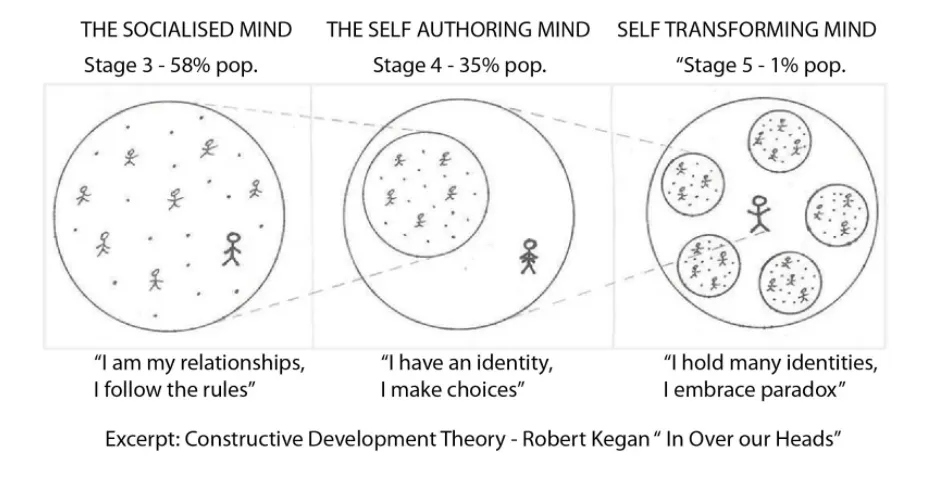
stage 3 – people people Duncan Sabien
https://open.substack.com/pub/homosabiens/p/the-people-vs-the-principles?r=1r8dq&utm_medium=ios
Indeed (in my experience), part of the “shamelessness” with which people-people flip-flop on their principles and easily shrug off accusations of hypocrisy is that they never actually identified with those principles in the first place.
they’re used to seeing lots of people pretend to principles that they don’t actually hold
stage 4 – principle people
stage 4 https://medium.com/@NataliMorad/how-to-be-an-adult-kegans-theory-of-adult-development-d63f4311b553
We can take responsibility for our own inner states and emotions — “I feel angry because I interpret what you did as a violation of important values of mine, and if I interpreted your actions differently I might feel sad instead.”
As I say, at the personal level this is something like realizing "I'm not me" or, put more formally, that the subject experiencing reality is not fully identified with itself, so that it's possible to simultaneously find some aspect of yourself being both the subject and object of a thought … For what it's worth, I also consider this stage to be where the Buddhist notion of stream entry happens. https://www.lesswrong.com/posts/bm96XvWfgEc88esHv/a-model-of-ontological-development